
For generations, women’s premenstrual experiences have been dismissed as purely “hormonal mood swings” or emotional instability. Understanding the respiratory link changes everything.
In the luteal phase (the second half of your cycle, about a week after ovulation), progesterone rises significantly. Progesterone stimulates respiration, signaling your body to breathe faster and more deeply. Most of the time, this goes unnoticed. I know it did for me—I wasn’t aware of it.
We all know that we bring oxygen into the body and remove carbon dioxide from the body. These gases need to stay more or less in balance. When you breathe faster during this phase of your cycle, you lose too much carbon dioxide. Low levels of carbon dioxide cause slight constriction of blood vessels (reducing oxygen delivery to the brain and tissues), and your nervous system shifts into a sympathetic state (fight-or-flight).
All of this can create physical symptoms such as anxiety, muscle tension, air hunger, and chest tightness.
Knowing this helps tremendously. You can see it differently now. When a sudden wave of irritability or anxiety hits, you can recognise it:
“My body is experiencing a temporary chemical shift,” or “My brain is responding to lower CO2 levels right now.”
In the simplest terms: When you’re in that phase of your cycle, you tend to breathe faster, which can cause symptoms such as anxiety, muscle tension, and so on.
WHAT TO DO & HOW TO APPROACH IT
Let your breathing be faster—don’t fight it. Your body is doing exactly what it is designed to do. Focus instead on the efficiency of your breath.
Rather than breathing high into your chest, bring your breath down into your middle body—the lower rib cage, where your diaphragm is located.
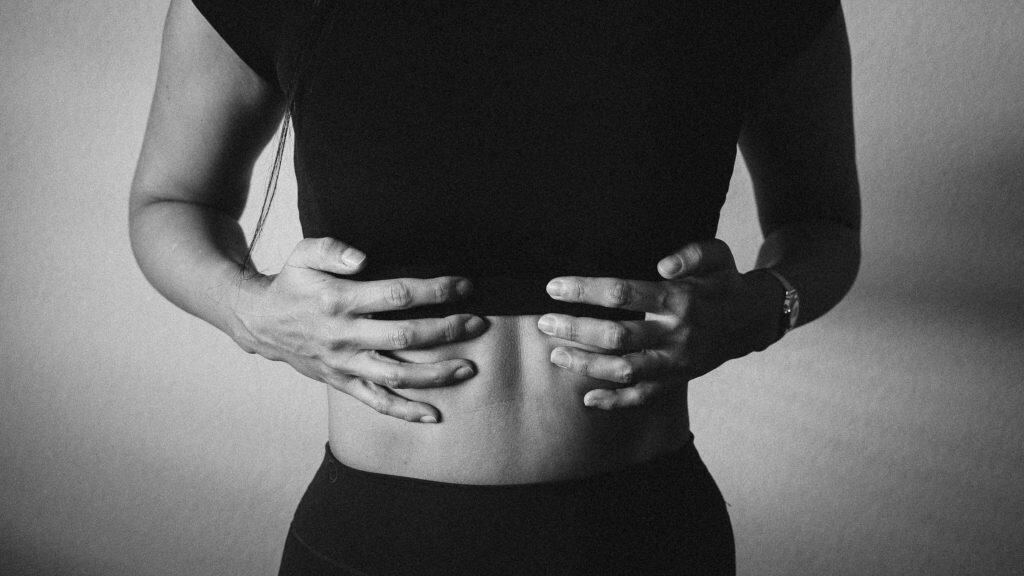
- Inhale through your nose, expand your lower rib cage. Keep the effort low and gentle.
- Exhale smoothly, allowing your middle narrow inward.
If it feels comfortable, pause naturally for just a second or two after you exhale. This small pause signals your body to relax.
If exhaling through the nose feels restrictive, then exhale softly through slightly parted lips. Exhaling through the mouth allows a more comfortable expulsion of air. I actually use it every time I feel tired or stressed.
One night when I went to bed, I noticed I was breathing faster than usual. At first, I wanted to force myself to slow down my breathing, but it felt wrong. Then I remembered I was in that phase of my cycle, and once I acknowledged it and allowed my breathing to be faster, I immediately felt calmer. When I stopped forcing my breath and worked instead on the efficiency of each inhale and exhale, everything shifted—I felt calm and relaxed.
Pregnancy Note:
Progesterone also remains high throughout pregnancy to maintain it, which continues to stimulate breathing. In fact, mild hyperventilation is very common during pregnancy, causing lower carbon dioxide levels that can sometimes trigger or heighten feelings of anxiety.
High Altitude Note:
If you go hiking at high altitude during the luteal phase, you may notice that breathing feels significantly more demanding. Altitude itself is a natural stressor on respiration, and when combined with elevated progesterone, your breathing drive increases even further. Keep this in mind, pace yourself, take it slower than usual, and let your body adapt efficiently.

References & Inspiration:
- Hormonal Physiology: Recognising and Treating Breathing Pattern Disorders (Leon Chaitow et al.), Chapter on Hormonal Influences on Breathing, p. 74.
- Inhale Expand, Exhale Narrow Concept: developed by Dr. Belisa Vranich (Breathe). Applied here by Adriana Petkova, Certified Breathing Instructor (The Breathe Institute / Dr. Belisa Vranich method).
- Practical Application & Insights: Personal documentation, alpine hiking observations, and coaching methodologies by Adriana Petkova (Relearn to Breathe).
Leave a Reply